
BOSSIP’s Black History Hidden Gems: Abdul Rahman Ibrahima Was The ‘Prince Among The Slaves’ Whose Story Spanned Continents & Centuries
Today, we’re launching BOSSIP’s Black History Hidden Gems, our weekly Black History Month series dedicated to uncovering overlooked Black figures, moments, and milestones. This series spotlights stories history nearly erased, but that legacy refused to forget.
Recognizing Black achievement during Black History Month is not only about honoring triumph, but about reclaiming narratives of resilience, intellect, and humanity that were, in some cases, deliberately buried. Few stories embody that mission more powerfully than the life of Prince Abdul Rahman Ibrahima.
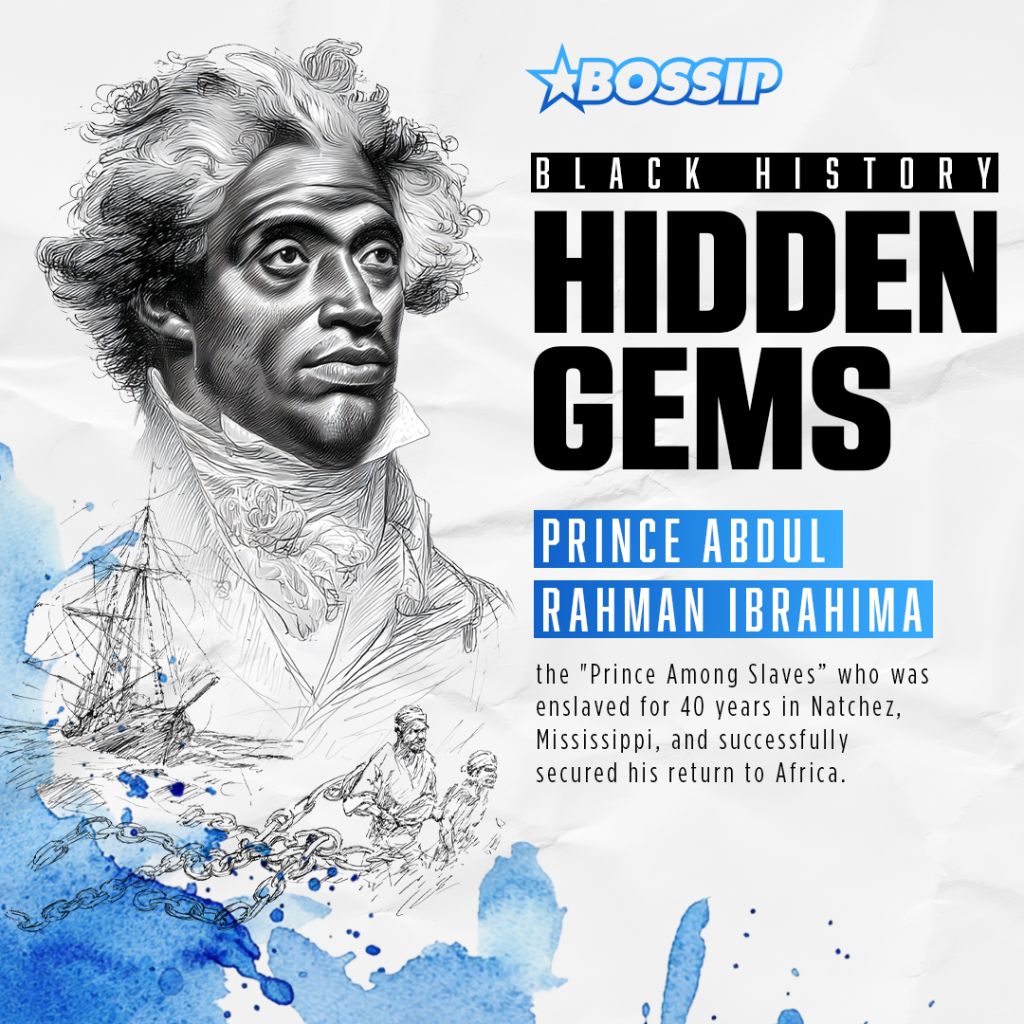
Prince Ibrahima arrived at a Natchez, Mississippi, river landing in 1788 chains, a stark contrast to the life he previously lived. Once a Muslim prince and colonel in his father’s army in West Africa who lived lavishly, he would spend the next 40 years doing soul-crushing work while enslaved on a plantation.
Born in 1762 and raised in Timbo in present-day Guinea, he was the son of King Sori, a powerful political and religious leader of the Futa Jallon highlands. His early life centered on education, faith, and discipline, and as a teenager, he traveled to study in the Islamic centers of Timbuktu and Djenné, where he learned Arabic and multiple African languages. By his mid-20s, he had risen through the ranks of the military, earning the honor and respect of the men he led, but violence abruptly disrupted that life.
In January 1788, rival forces ambushed Ibrahima and his soldiers as they returned from a military victory. Captors sold him into the transatlantic slave trade, where he passed through the Caribbean and New Orleans before traders sent him up the Mississippi River to Natchez, where plantation owner Thomas Foster purchased him.
History.com notes that Ibrahima remained resilient and refused to be hidden, telling Foster that he was a prince whose family would pay for his return home. Not so shockingly, the master ignored him and instead reduced his identity to a nickname, mockingly calling him “Prince” while denying its truth.
For years, survival replaced sovereignty for the royal, that is, until he experienced a life-altering reunion. History.com reports that while selling produce at a marketplace near Natchez, he encountered Dr. John Coates Cox, an Irish physician he had known as a child in West Africa. He was an ally to the prince because, years earlier, the doctor had fallen ill and become stranded in Futa Jallon, where Ibrahima’s family cared for him. Grateful for his life and distraught at seeing the prince enslaved, Cox spent nearly 20 years trying to purchase Ibrahima’s freedom. After his death, his son continued the effort, but neither succeeded–but something else did.
Years later, newspaper publisher Andrew Marschalk noticed Ibrahima reading Arabic fluently in his Natchez print shop and recognizing his intellect, Marschalk agreed to help him write a letter intended for his homeland. In 1826, Ibrahima wrote the letter, which Marschalk forwarded to U.S. Sen. Thomas Buck Reed. Reed sent it to Washington, D.C.
According to History.com, the correspondence reached international officials, including the sultan of Morocco, who offered to pay for Ibrahima’s freedom. His Arabic handwriting caused the sultan to believe that Ibrahima was a North African Moor, not an African Muslim, and Ibrahima was wise not to correct. The Sultan of Morocco requested that President John Quincy Adams and Secretary of State Henry Clay arrange Ibrahima’s release in 1829. Slavemaster Foster agreed to let Ibrahima go on the condition that he immediately leave the United States. Before departing, however, Ibrahima and his wife, Isabella, traveled to Washington, where he worked with government officials and the American Colonization Society to raise money to free his nine children. In 1829, Ibrahima and his wife sailed to Liberia under the society’s sponsorship, but shortly after arriving, Ibrahima fell ill and died.
And while he never returned to his homeland, his legacy lives on. Nearly two and a half centuries after his death, the city of Natchez, Mississippi, formally honored his legacy with a historical marker placed near the site where his journey toward freedom began.
Mississippi Today reports that the marker was unveiled on Oct. 24 at the corner of U.S. 61 North and Jefferson College Street near Historic Jefferson College. At the Natchez ceremony honoring his life, Roscoe Barnes III, president of the Mississippi Historical Society and cultural heritage and tourism manager at Visit Natchez, told the outlet that the recognition was long overdue.
“We believed it was time to honor his life and his legacy,” Barnes said, describing Ibrahima’s journey as one of the most remarkable stories to come out of the region and one that holds both pain and hope.”
“It is a story about darkness, a story about pain, suffering, enslavement, but that’s not all. It is a story about hope,” he said.

Ultimately, Prince Abdul Rahman Ibrahima’s story centers on his unbroken sense of self that survived against the odds. Enslavement denied his freedom, but it never diminished his identity, intellect, or belief in his own worth. Even after decades in bondage, he carried his history with him, proving that sovereignty of spirit can endure even when the body is bound.
By revisiting lives like his with BOSSIP’s Black History Hidden Gems, we do more than remember the past. We restore visibility and honor Black excellence that spans generations, while ensuring these hidden gems finally receive the recognition they deserve.
The post BOSSIP’s Black History Hidden Gems: Abdul Rahman Ibrahima Was The ‘Prince Among The Slaves’ Whose Story Spanned Continents & Centuries appeared first on Bossip.